
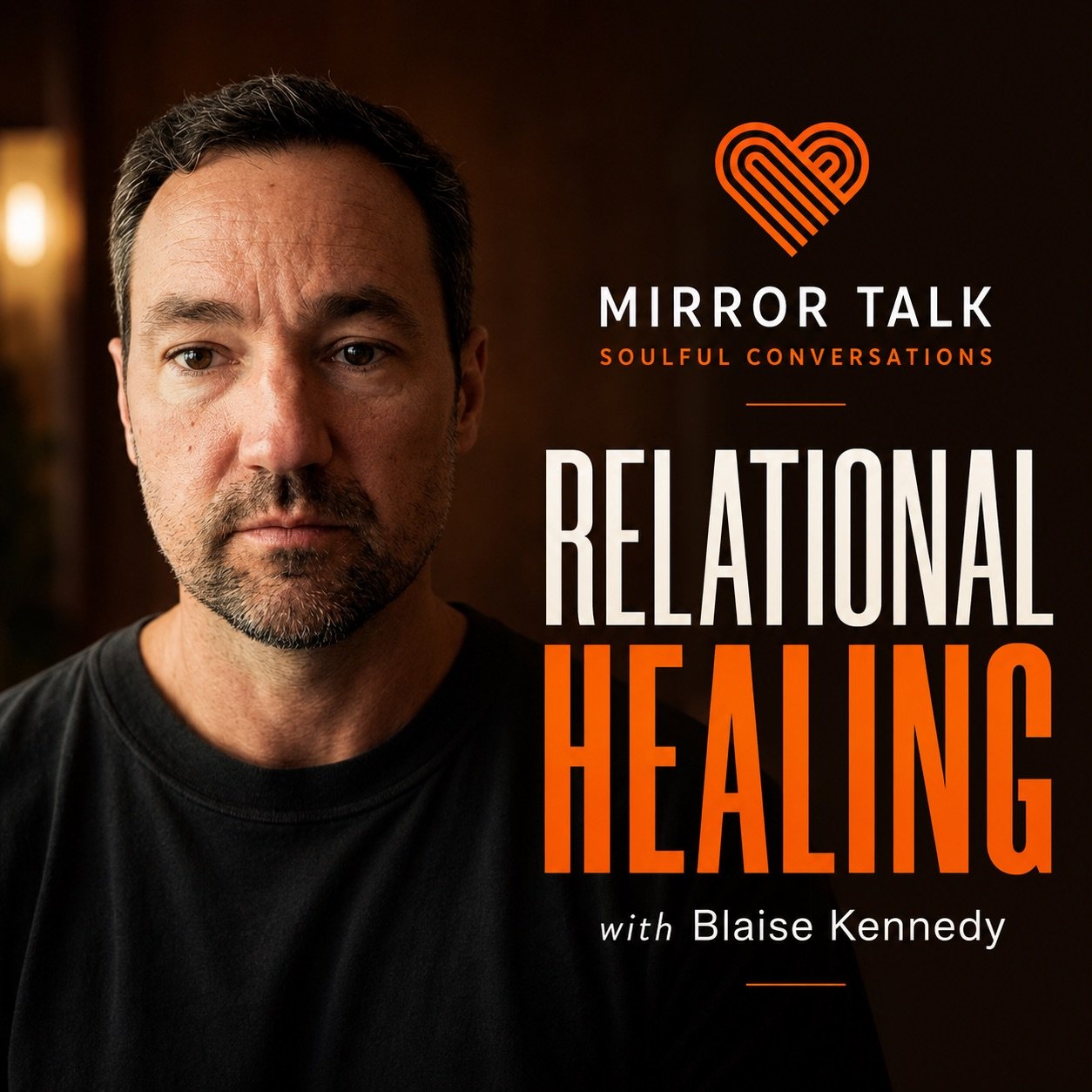
Discover how trauma repair, nervous system capacity, relational healing, and embodied awareness can turn spiritual insight into lasting transformation.
Why do moments of spiritual insight not always lead to meaningful change in our bodies, relationships, and everyday lives?
In this episode of Mirror Talk: Soulful Conversations, host Tobi Ojekunle speaks with Blaise Kennedy, a spiritual teacher and the creator of Developmental Architecture.
Blaise works at the intersection of spiritual awakening, trauma repair, embodied awareness, relational attunement, and nervous system capacity. His work focuses on creating the conditions in which insight can become lived transformation.
Blaise Kennedy’s Journey from Addiction to Spiritual Awakening
Blaise’s personal journey was deeply shaped by the loss of his father at the age of 12, substance abuse during his teenage years and early adulthood, and his decision to enter recovery at 24.
Recovery became the beginning of a deeper process of self-inquiry, meditation, healing, and spiritual integration.
Rather than presenting awakening as an escape from painful human experiences, Blaise describes a path of learning to remain present with the body, emotions, relationships, and unresolved history.
His experiences as a husband, foster parent, and father of three have also helped mature his understanding of presence, responsibility, and relational healing.
Why Insight Alone Does Not Create Transformation
A person can understand the origin of a pattern and still repeat it.
We may recognise that a fear belongs to the past while continuing to experience it physically in the present. We may understand our attachment patterns intellectually but still become overwhelmed when intimacy, conflict, or vulnerability arises.
Insight is important because it helps us see what is happening. Embodiment is the process through which that awareness becomes integrated into our nervous system, behaviour, relationships, and choices.
This integration usually requires:
- Emotional and physical safety
- Consistent practice
- Honest relationships
- Slow, sustainable pacing
- Greater awareness of bodily sensations
- Opportunities to experience new responses
- Compassion for the adaptations that once protected us
Lasting transformation is less about forcing ourselves to change and more about creating conditions in which the system no longer needs to rely on the same protective patterns.
Understanding the conversation
What Is Developmental Architecture?
Developmental Architecture is Blaise Kennedy’s embodied and relational framework for human development.
It explores how important human capacities—including safety, emotional aliveness, personal agency, love, expression, perception, and connection—develop through the body, nervous system, and relationships.
Early experiences shape how these capacities become organised. When a person does not receive adequate safety, attunement, encouragement, or emotional support, the nervous system adapts.
Those adaptations can continue into adulthood and influence:
- How we respond to stress
- Whether we feel safe in relationships
- How easily we express our needs
- Our ability to trust and receive support
- How we handle conflict
- Whether we remain present with difficult emotions
- Our sense of identity and belonging
Developmental Architecture helps people explore how these patterns were formed and what relational conditions may allow greater integration and maturity.
Why Healing Happens Through Relationship
One of the central themes of the episode is that healing is not entirely a solo process.
Meditation, self-reflection, reading, and journaling can help us develop awareness. However, relationships reveal patterns that may remain hidden when we are alone.
Within relationships, we encounter vulnerability, misunderstanding, love, rejection, closeness, boundaries, and emotional activation. These experiences show us where we have developed the capacity to remain present and where protective patterns still take over.
Safe and attuned relationships can help us experience something different.
We can learn that it is possible to:
- Express an emotion without losing connection
- Set a boundary without abandoning another person
- Receive care without becoming dependent
- Remain present without performing
- Tell the truth without disappearing
- Experience disagreement without assuming the relationship is over
Healing relationships do not remove personal responsibility. They help us move from isolation and hyper-independence towards healthy interdependence.
How Trauma Lives in the Present
During the conversation, Blaise reflects on Thomas Hübl’s words:
“Presence is integrated history.”
The past can remain active in our bodies and relationships long after an event has ended.
It may appear through tension, emotional numbness, hypervigilance, recurring conflict, avoidance, people-pleasing, or difficulty receiving love.
As Blaise says:
“The past is alive in the present moment.”
Integration does not mean erasing the past. It means developing enough capacity to recognise, feel, and include what remains unfinished without becoming completely overwhelmed by it.
As more of our history becomes integrated, we gain greater freedom to respond to the present rather than automatically repeating the past.
Healing in practice
The Connection Between Awakening, Healing and Intimacy
Spiritual awakening, trauma healing, manifestation, and intimate relationships are often discussed as separate subjects.
Blaise presents them as parts of one path.
Our ability to participate fully in life depends partly on our capacity to remain present in the body, tolerate emotional experience, maintain connection, and act from a grounded sense of self.
A spiritual insight may reveal our fundamental connectedness. Relational practice then asks us to embody that understanding while listening, speaking honestly, navigating conflict, and caring for another person.
Healing helps expand our capacity for presence. Relationships reveal where that capacity remains limited.
Spiritual practice can then support us in meeting those limitations with awareness rather than shame.
Key Lessons from This Episode
Listeners will discover:
- Why awareness does not always produce behavioural change
- How trauma and developmental experiences affect the nervous system
- Why safety and relational attunement support healing
- What Developmental Architecture means
- How relationships mirror our inner patterns
- Why emotions are designed to move through connection
- How spiritual awakening can become grounded in daily life
- Why slow and consistent practice can be more transformative than chasing peak experiences
- What to practise when you feel stuck between insight and embodiment
Listen to the Full Conversation
This episode is for anyone who has gained significant self-awareness but still feels blocked in their body, relationships, or everyday life.
Blaise’s work reminds us that transformation does not have to be forced. Sometimes, growth begins by creating the safety, connection, and consistency that allow what is already within us to emerge.
Follow the podcast on your preferred listening platform and share this episode with someone exploring spiritual awakening, trauma healing, or embodied personal growth.
Watch on YouTube: https://youtu.be/rQEo3WRPIZA
Connect with Blaise Kennedy
Official website: https://www.blaisekennedy.com/
Developmental Architecture: https://www.blaisekennedy.com/developmental-architecture
One Experience: Consciousness and the Absolute: https://app.acuityscheduling.com/schedule.php?owner=19405918&appointmentType=95753357&field:18867415=MIRRORTALK
About Mirror Talk: Soulful Conversations
Mirror Talk is a podcast for people seeking to live with greater wisdom, purpose, spiritual grounding, self-awareness, and authenticity.
Discover more episodes at: https://mirrortalkpodcast.com
Living With Cancer: Resilience, Hope and Evidence-Based Decisions (Dale Atkinson) – Mirror Talk: Soulful Conversations
- Living With Cancer: Resilience, Hope and Evidence-Based Decisions (Dale Atkinson)
- Someone Told Me To Stop Doing This (And They Were Right)
- Why Manifestation Isn’t Working: Resistance, Self-Love & Divine Timing (Kelsey Aida)
- Why You Need A 'Champion Mindset' To Win In Life
- Spiritual Awakening, Surrender & Ego Management (with Cristine Hull)