
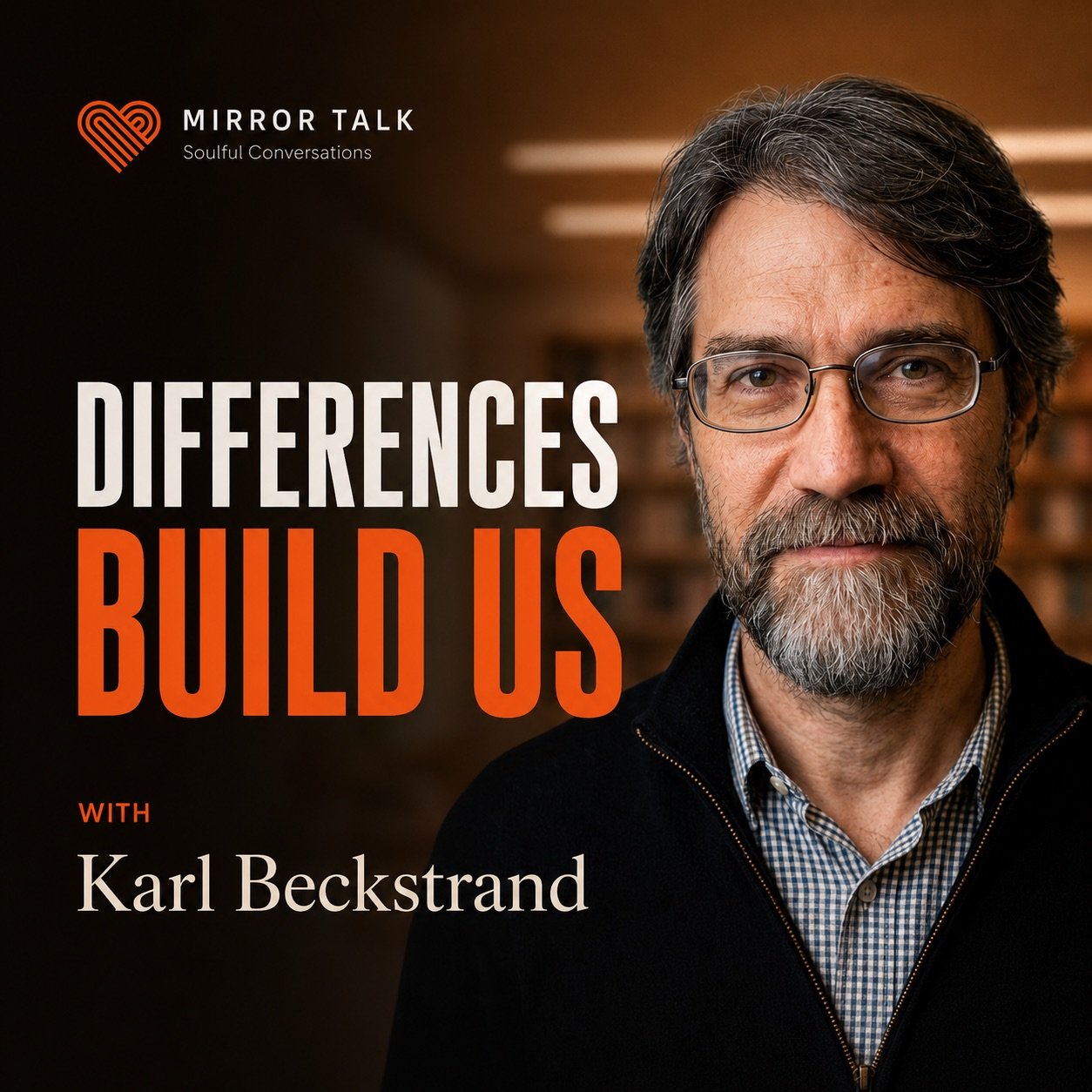
Karl Beckstrand explores sex, emotional intimacy, identity, faith and how honest connection can help us build fulfilling relationships that last.
What are we truly searching for when we desire another person?
Is it sex alone—or are we also longing to feel known, accepted, valued, safe and emotionally connected?
In this episode of Mirror Talk: Soulful Conversations, Tobi speaks with college media instructor, conflict-resolution graduate and award-winning author Karl Beckstrand about sexuality, emotional intimacy and the formation of lasting relationships.
Karl is the author of Abundant Paths: Beyond Either/Or Thinking to Fulfilling Same-Sex Relationships That Last. Drawing from his personal experiences, he challenges listeners to examine the needs beneath attraction and to consider forms of connection that extend beyond conventional romantic and sexual expectations.
The paradox of sex
Karl describes what he calls the paradox of sex: sex can create feelings of closeness while sometimes making genuine emotional bonding more complicated.
For Karl, taking sex off the table in certain relationships created space for a different kind of intimacy. Without the pressure of pursuing a sexual outcome, he found it easier to develop trust, affection, honesty and lasting connection.
His point is not that sex is inherently harmful. Rather, he encourages people to consider whether sexual activity is meeting their deeper needs—or temporarily distracting them from those needs.
A person may desire affection, affirmation, belonging or emotional safety while interpreting the discomfort created by those unmet needs primarily as sexual frustration. Understanding the difference can lead to healthier decisions and more satisfying relationships.
Ask a human question. Receive insight grounded in real conversations.
One partner cannot meet every emotional need
Many people enter romantic relationships with an unspoken expectation that one person should become their lover, best friend, emotional adviser, primary source of affection and complete support system.
That expectation can place enormous pressure on a relationship.
Karl argues that healthy friendships, family relationships, communities and other meaningful connections should not disappear when someone enters a romantic partnership. People need different forms of connection, and attempting to receive everything from one partner can contribute to disappointment, resentment and isolation.
This does not mean ignoring appropriate relationship boundaries. It means recognising that friendship and community remain essential parts of emotional well-being.
A strong relationship should not require a person to abandon every other source of healthy human connection.
Honesty creates trust
Trust is not built through appearances. It is developed when people can speak truthfully about their emotions, attractions, fears, expectations and boundaries.
Karl explains that hiding important feelings can create distance, even when someone believes the secrecy is protecting the relationship. Honest communication gives both people an opportunity to understand what is happening and decide together how it should be handled.
Honesty, however, is not permission to behave without consideration for another person. Vulnerability must be accompanied by empathy, responsibility and respect.
Healthy relational honesty asks:
- What am I genuinely feeling?
- What need may be underneath this feeling?
- What agreements have we made?
- How might my choices affect the other person?
- What would love and integrity require from me?
Attraction is not the same as action
One of the most valuable distinctions in the conversation is the difference between experiencing attraction and deciding what to do with it.
People do not always choose the feelings or attractions that arise within them. They can, however, become more conscious of how they interpret those feelings and how they respond.
Karl encourages listeners to become curious rather than immediately ashamed or impulsive. An attraction may contain information about admiration, emotional longing, identification, affection or a desire for belonging. It does not automatically prescribe a particular action.
This space between feeling and action allows people to respond with greater clarity.
Finding an identity beyond restrictive labels
Labels can help people describe their experiences, find community and communicate more clearly. They can also become restrictive when a person feels pressured to make every part of life conform to one category.
Karl’s perspective is that authentic identity should be larger than sexual attraction alone.
A person is also shaped by values, character, relationships, faith, creativity, experiences, choices and the ways they contribute to the lives of others.
The goal is not to deny sexuality. It is to prevent one dimension of human experience from becoming the only definition of the person.
Faith, sexuality and belonging
Karl also discusses the influence of faith on his understanding of sexuality and relationships.
For people navigating both spiritual belief and diverse attractions, the conversation can be deeply personal and emotionally difficult. Karl encourages listeners to begin with the conviction that every person is worthy of love, dignity and meaningful connection.
Faith should not become a reason to isolate people or deny their need for belonging. At its best, it can invite greater honesty, compassion, humility and care.
Karl’s interpretation will not reflect every religious or LGBTQIA perspective. Nevertheless, his story opens space for an important conversation about how people can approach sexuality and spirituality without reducing either subject to fear, condemnation or simplistic answers.
What makes a relationship fulfilling?
A fulfilling relationship is not sustained by attraction alone.
It grows through:
- Honest and respectful communication
- Emotional availability
- Mutual trust
- Shared values
- Appropriate boundaries
- Affection and appreciation
- Friendship and community
- The willingness to understand another person’s needs
- Commitment to each other’s well-being
As Karl explains, real love is not simply about wanting another person. It also involves wanting what is genuinely good for them.
Final reflection
The central question from this conversation is not whether sex is good or bad.
The deeper question is:
What are we truly seeking through our relationships, and are we meeting those needs in healthy and honest ways?
When people understand their emotional needs, communicate openly and develop meaningful connections beyond a single romantic relationship, they may become less dependent on sex, labels or external validation to feel complete.
Listen to the complete conversation with Karl Beckstrand on Mirror Talk: Soulful Conversations.
Watch on YouTube: https://youtu.be/HHkiMS10QeA
Try Aletheia today: https://aletheia.mirrortalkpodcast.com
Ask what is on your heart. Mirror Talk will reflect back what may help you see more clearly. Try it here: https://mirrortalkpodcast.com/ask-mirror-talk/
Thank you for joining me on this MIRROR TALK podcast journey. Please subscribe to any platform and remember to leave a review and rating.
Stay connected: https://lnkfi.re/mirrortalk
More inspiring episodes and show notes are here: https://mirrortalkpodcast.com/podcast-episodes/
Your opinions, thoughts, suggestions, and comments are important to us. Please share them here: https://mirrortalkpodcast.com/your-opinion-matters/
Could you support us by becoming a Patreon? Please consider subscribing to one or more of our offerings at http://patreon.com/MirrorTalk
All proceeds will help enhance the quality of our work and outreach, enabling us to serve you better.
We use and trust these podcasting tools, software, and gear. We’ve partnered with amazing platforms to give our Mirror Talk community exclusive deals and discounts: https://mirrortalkpodcast.com/best-podcasting-tools/
Someone Told Me To Stop Doing This (And They Were Right) – Mirror Talk: Soulful Conversations
- Someone Told Me To Stop Doing This (And They Were Right)
- Why Manifestation Isn’t Working: Resistance, Self-Love & Divine Timing (Kelsey Aida)
- Why You Need A 'Champion Mindset' To Win In Life
- Spiritual Awakening, Surrender & Ego Management (with Cristine Hull)
- Your Daily Dose Of Positivity: Start Here (with Rhonda Britten)