
Begin with the question
But what if there is another way?
Discover how to release emotional pain with Marty Simon's practical approach to difficult emotions, overthinking, grief, and inner peace.
How do you release emotional pain when your mind keeps replaying the past, your emotions feel overwhelming, and peace seems just out of reach?
Most of us have tried to think our way out of emotional discomfort. We distract ourselves, resist uncomfortable feelings, search for answers, or hope that changing our circumstances will finally bring relief.
But what if there is another way?
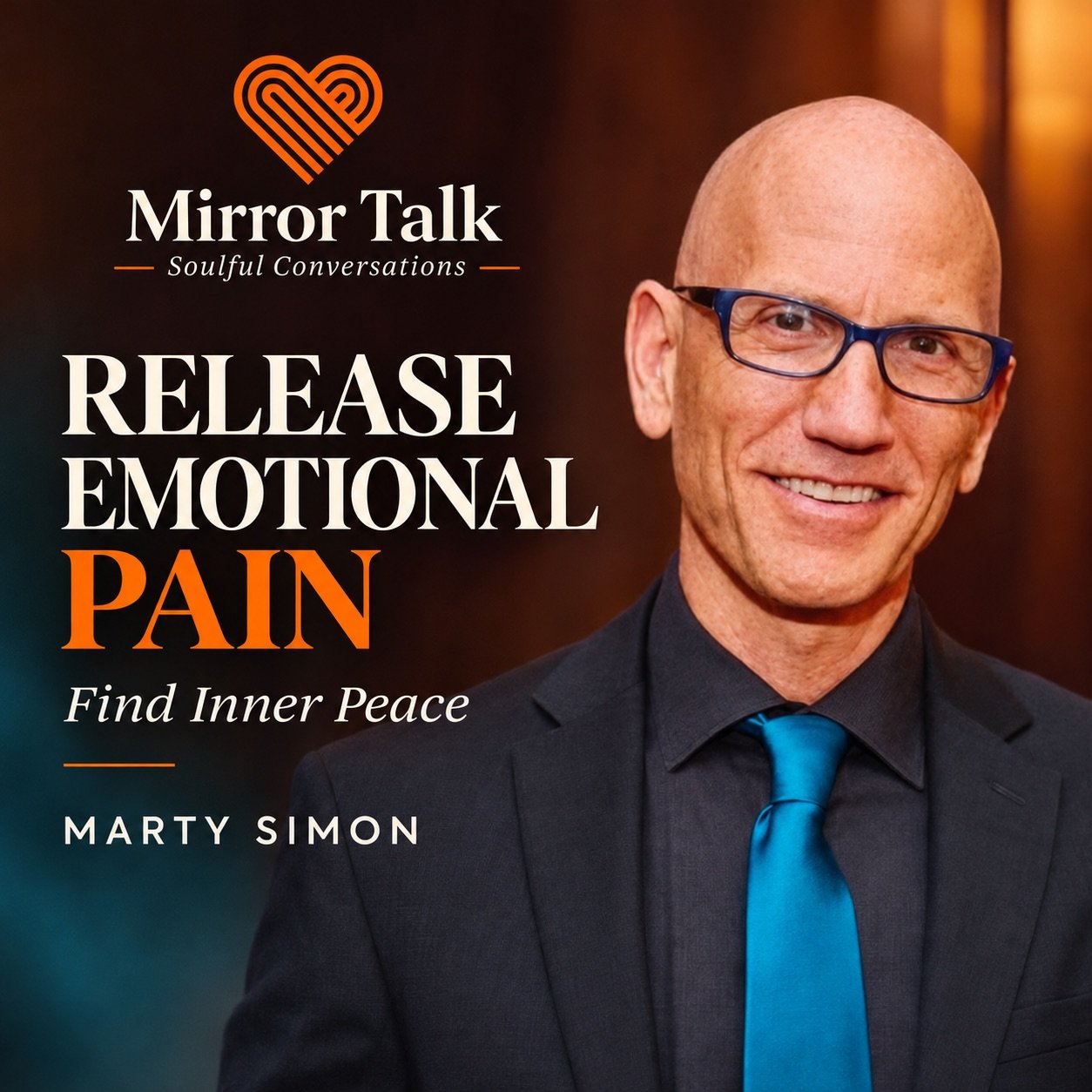
In this episode of Mirror Talk: Soulful Conversations, host Tobi sits down with Marty Simon, a retired professor, spiritual teacher, meditation group leader, and author of Spirituality for Effective Living: Teachings of the Masters Through an Unenlightened Disciple.
Their conversation explores a powerful possibility: that we can learn to relate differently to our thoughts and emotions without having to control everything happening around us.
You Are Not Every Thought That Passes Through Your Mind
Have you ever noticed how quickly a thought can change your mood?
A memory appears, and suddenly you feel regret. Someone doesn’t respond to your message, and your mind begins inventing explanations. An uncertain future becomes a series of imagined disasters.
Marty offers a simple but important distinction.
You are not necessarily the voice producing those thoughts. You can also notice that voice.
As he explains:
“The mind is a useful tool and a lousy master.”
Rather than trying to force the mind into silence, Marty encourages us to become more aware of our relationship with it.
A thought can arise without becoming a command. A worry can be noticed without automatically being treated as a prediction. A critical inner voice can speak without determining our worth.
This shift from identification to observation is central to his approach to spiritual growth and self-awareness.
How to Release Emotional Pain Instead of Fighting It
When difficult emotions surface, two responses often seem available.
We can suppress what we feel, pretending it isn’t there. Or we can express it outwardly through anger, withdrawal, blame, or impulsive reactions.
Marty introduces a third possibility: releasing.
In his spiritual practice, releasing means allowing an emotion to be experienced without immediately resisting it or acting it out.
He describes paying attention to the body’s physical sensations, relaxing rather than tightening against them, and giving the feeling space.
A gentle approach to emotional release
If a mild uncomfortable feeling arises, consider these steps inspired by Marty’s teaching:
- Notice the emotion. Recognise what is happening without immediately judging it.
- Relax your body. Soften areas of tension, particularly around the chest, shoulders, and abdomen.
- Observe the sensation. Pay attention to how the feeling shows up physically, rather than getting lost in the story surrounding it.
- Allow yourself some space. You do not have to suppress the emotion, explain it away, or react immediately.
- Return to the present. When you feel ready, consider what action, if any, the situation actually requires.
This is a spiritual and reflective practice, not a requirement to endure overwhelming emotions or a replacement for professional mental health support.
The invitation is to discover whether meeting manageable discomfort with greater awareness can change how we experience it.
Why External Success Cannot Solve Every Internal Struggle
We often organise our lives around the next achievement.
The promotion. The relationship. The financial milestone. The recognition. The moment when everything finally falls into place.
These goals can be meaningful. But Marty challenges the expectation that external achievements can permanently resolve an internal sense of lack.
As he puts it:
“If you’re trying to solve an internal problem by changing the outside, there is no amount that’s going to do it.”
This raises an important question.
Are we pursuing something because it is meaningful to us, or because we expect it to make us feel complete?
For Marty, joy, love, and peace are not necessarily rewards waiting at the end of a perfect life.
He compares them to sunshine obscured by clouds. The challenge, in his view, is not always to manufacture more light, but to understand what is standing between us and our experience of it.
Letting Go of Grief Does Not Mean Letting Go of Love
One of the most moving parts of this conversation explores grief.
Marty reflects on the emotional pain he experienced when his wife left him and what that period taught him about suffering, attachment, and releasing difficult emotions.
His experience leads into a wider reflection on loss.
People sometimes fear that healing means abandoning the person, relationship, or chapter of life they still hold dear.
But Marty offers another perspective:
“The more we release the grief, the more we can love.”
Releasing grief, from this perspective, is not the same as erasing memories or denying the significance of loss.
Love can remain meaningful even as our relationship with pain gradually changes.
Grief has no universal timetable, and no one needs to force themselves to let go before they are ready. The conversation simply opens space to consider whether healing and remembering can coexist.
Spirituality as a Personal Science of Living
Marty describes spirituality as a “personal science of living.”
Rather than asking people to accept a particular set of beliefs, he encourages them to explore teachings through observation, personal experience, and everyday practice.
Does a practice help you respond more consciously?
Does it improve the way you relate to people?
Does it create more room for love, joy, and peace?
These questions make spirituality practical rather than purely theoretical.
Drawing on his journey with Yogi Amrit Desai and Michael Singer, Marty explains why spiritual understanding becomes meaningful when it changes how we live.
Finding Peace Without Fighting Life
Another important insight from the conversation is the distinction between participating in life and trying to control it.
Accepting that something has happened does not necessarily mean approving of it or refusing to take action.
It can mean responding to reality as it is, instead of using all our energy resisting the fact that it is happening.
We can still set boundaries, pursue change, work toward meaningful goals, and address difficult circumstances.
But perhaps we can do so without turning every unexpected event into an internal battle.
An Invitation to Reflect
The next time an uncomfortable thought or emotion arises, you might ask yourself:
Can I notice what is happening without allowing it to define who I am?
You do not need to answer perfectly.
You do not even need to change how you feel immediately.
Sometimes personal growth begins with the simple recognition that we have more choices in how we respond than we first realise.
Listen to the Full Conversation
Join Tobi and Marty Simon on Mirror Talk: Soulful Conversations as they explore emotional release, mindfulness, grief, self-awareness, and the search for lasting inner peace.
This episode is for anyone who has been carrying emotional pain, feeling overwhelmed by their thoughts, or questioning whether greater peace is possible in ordinary life.
Watch on YouTube: https://youtu.be/O4SssEZzvZw
About Marty Simon
Marty Simon is a retired professor, spiritual teacher, meditation group leader, and author of Spirituality for Effective Living: Teachings of the Masters Through an Unenlightened Disciple.
Through his writing and spiritual teaching, he offers practical reflections on stress, anxiety, self-awareness, emotional release, and living with greater joy, love, and peace.
Read Marty’s writing: https://martysimon.substack.com
Explore more soulful conversations: https://mirrortalkpodcast.com
If this episode resonates with you, share it with someone who might benefit from a gentler relationship with their thoughts and emotions.
Keep reflecting. Keep growing. Keep shining your light.