
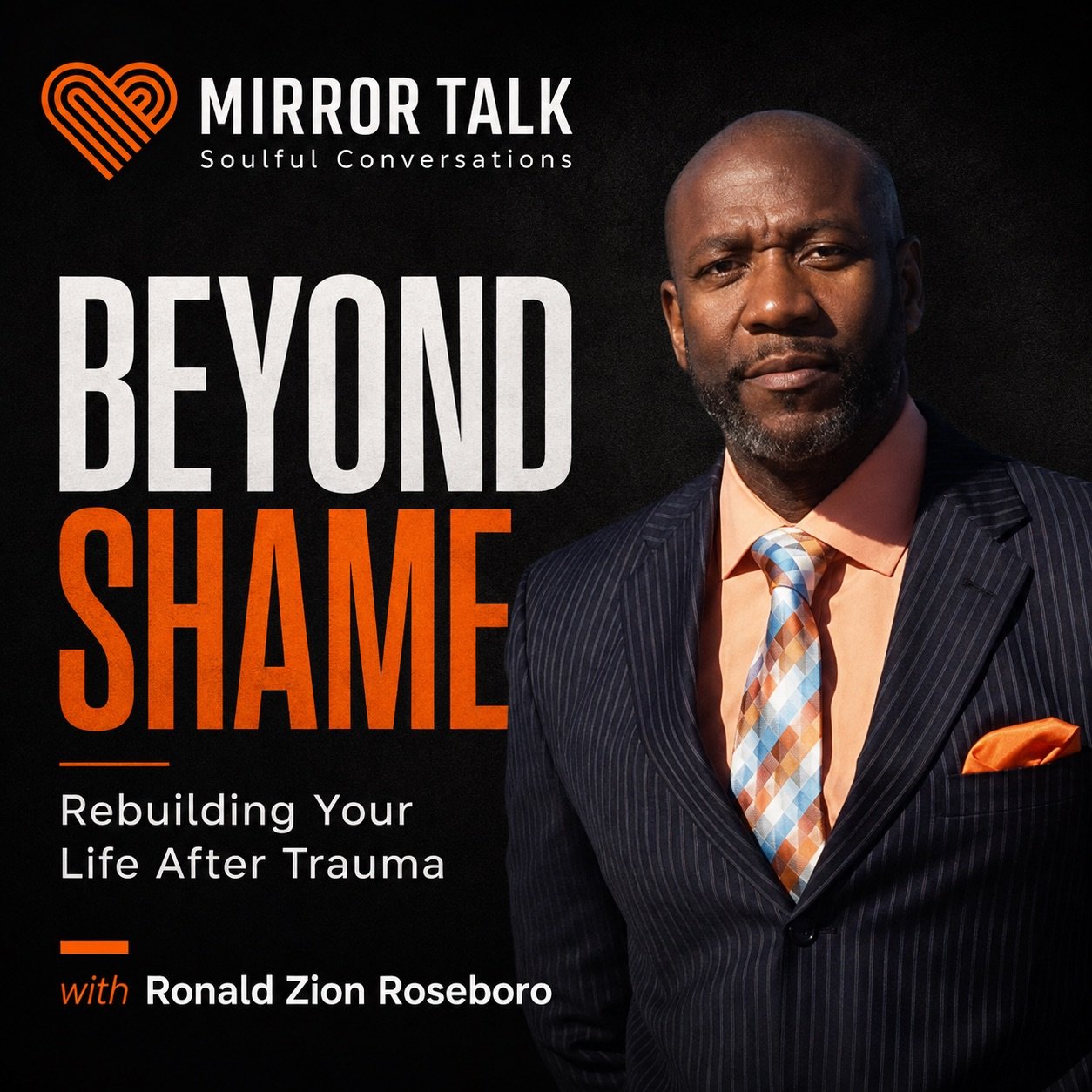
How do you rebuild after trauma, shame and incarceration? Ronald Zion Roseboro shares the BRICK Method, emotional healing, faith and identity.
There are experiences in life that do more than hurt us.
They can change the way we see ourselves.
Trauma, rejection, grief, addiction, failure, incarceration and loss can slowly become more than things that happened to us. If we are not careful, they can become part of the story we tell ourselves about who we are.
That distinction sits at the heart of our conversation with Ronald Zion Roseboro on Mirror Talk: Soulful Conversations.
Ronald is a minister, author, trauma-informed coach and founder of The Shame Free Life Coaching and Consulting. His work today focuses particularly on helping men heal from trauma, understand their emotions, reclaim their identity and move beyond shame.
But his work was born from experiences he first had to confront in his own life.
When Life Has to Be Rebuilt
Ronald’s journey includes incarceration, compounded trauma, rejection, grief and profound loss.
After his release from prison in 2004, freedom did not automatically mean that the emotional consequences of what he had experienced disappeared.
There was still rebuilding to do.
That rebuilding involved practical challenges, but perhaps even more importantly, it required Ronald to confront an internal question:
Am I what happened to me?
Ask a human question. Receive insight grounded in real conversations.
One of the most important themes of our conversation is the difference between our experiences and our identity.
We can acknowledge our past without allowing it to dictate our future.
That does not require pretending the painful chapters never happened. In fact, healing often demands the opposite.
It requires turning toward those experiences honestly.
Shame Says More Than “I Made a Mistake”
There is an important difference between recognizing that we have made mistakes and believing that we ourselves are the mistake.
Shame can move the conversation from:
“Something happened.”
or
“I did something I regret.”
to:
“Something is fundamentally wrong with me.”
Once shame becomes part of our identity, it can influence relationships, self-worth, emotional health and the decisions we make about our future.
For people who have experienced trauma, rejection, addiction, incarceration or failure, those internal narratives can become especially powerful.
Healing therefore involves more than changing external circumstances.
Sometimes we must change the way we relate to ourselves.
Why So Many Men Suffer in Silence
Our conversation also explores something Ronald encounters repeatedly in his work with men: emotional suppression.
Many men grow up learning that strength means enduring pain quietly.
Do not cry.
Do not admit fear.
Do not reveal uncertainty.
Do not let anyone know that you are struggling.
But emotions do not disappear simply because they remain unspoken.
Ronald challenges the idea that acknowledging pain makes a man weak.
Instead, emotional regulation begins with recognizing what we are experiencing and learning how to respond intentionally rather than allowing unresolved emotions to control our behaviour.
Healthy manhood, in this sense, is not emotional numbness.
It is emotional maturity.
The BRICK Method: Rebuilding One Piece at a Time
Ronald developed the BRICK Method as a framework for rebuilding after adversity.
BRICK represents:
Breakthrough
Resilience
Identity
Clarity
Kickstart
The metaphor is powerful because rebuilding rarely happens overnight.
A destroyed structure is not restored by wishing that it had never fallen.
It is rebuilt intentionally.
Brick by brick.
The same can be true of a life.
Experiences that once felt like evidence of our destruction can eventually become part of the wisdom, compassion, resilience and purpose with which we build the next chapter.
That does not mean calling trauma good.
It means refusing to allow trauma to have the final word.
What Happens When Trauma Affects Faith?
Ronald also speaks openly about complicated grief and his relationship with God.
Faith does not always remove difficult questions.
Sometimes our deepest losses make those questions louder.
Where was God?
Why did this happen?
Why was this allowed?
What do I do with anger, disappointment and grief when I still want to believe?
Our conversation creates room for a spirituality that does not demand emotional dishonesty.
Faith and grief can exist in the same heart.
So can trust and unanswered questions.
Sometimes healing is not finding a neat explanation for everything that happened.
Sometimes it is learning to keep walking without one.
Reclaiming Personal Power
Another important distinction Ronald makes is between moving forward and pretending the past never happened.
Reclaiming personal power is not denial.
It is recognizing that although we cannot rewrite the beginning of our stories, we still have agency over what we build from where we stand today.
The past may influence us.
It may wound us.
It may teach us.
But it does not automatically receive ownership of our future.
Perhaps that is why one question emerges so powerfully from this conversation:
Who Am I?
Not:
Who did people say I was?
Who was I during the worst chapter of my life?
What happened to me?
What did I lose?
What did I do?
But:
Who am I now—and who am I becoming?
That question is not only for people recovering from incarceration or extreme trauma.
It belongs to all of us.
Because sooner or later, life gives each of us moments when the identity we once carried no longer fits.
And sometimes rebuilding begins with giving ourselves permission to discover who we are again.
Listen to the full conversation
Listen to Beyond Shame: Rebuilding Your Life After Trauma (with Ronald Zion Roseboro) on Mirror Talk: Soulful Conversations.
Connect with Ronald
Website: https://theshamefreelife.com
LinkedIn: https://www.linkedin.com/in/ronaldzionroseboro
The Brick Method: https://amazon.com/brick-method-ronald-zion-roseboro
Watch on YouTube: https://youtu.be/wBjOCteoy7Q
Continue Your Journey
Read CONFESSIONS: A personal invitation to reflection, healing and honest self-discovery: https://mirrortalkpodcast.com/confessions-book/
Try Aletheia: Receive calm, personalised biblical wisdom for the questions and decisions shaping your life: https://aletheia.mirrortalkpodcast.com
Ask Mirror Talk: Share what is on your heart and receive a thoughtful reflection that may help you see your situation more clearly: https://mirrortalkpodcast.com/ask-mirror-talk/
Support Mirror Talk
Thank you for being part of the Mirror Talk: Soulful Conversations community.
Follow or subscribe on Spotify, Apple Podcasts or your preferred podcast platform so you do not miss future conversations about personal growth, spirituality, healing, purpose, relationships, leadership and intentional living.
Your rating, review and shared recommendation help more people discover the podcast.
You can also support our work and outreach by becoming a Mirror Talk Patreon member: http://patreon.com/MirrorTalk
Someone Told Me To Stop Doing This (And They Were Right) – Mirror Talk: Soulful Conversations
- Someone Told Me To Stop Doing This (And They Were Right)
- Why Manifestation Isn’t Working: Resistance, Self-Love & Divine Timing (Kelsey Aida)
- Why You Need A 'Champion Mindset' To Win In Life
- Spiritual Awakening, Surrender & Ego Management (with Cristine Hull)
- Your Daily Dose Of Positivity: Start Here (with Rhonda Britten)