

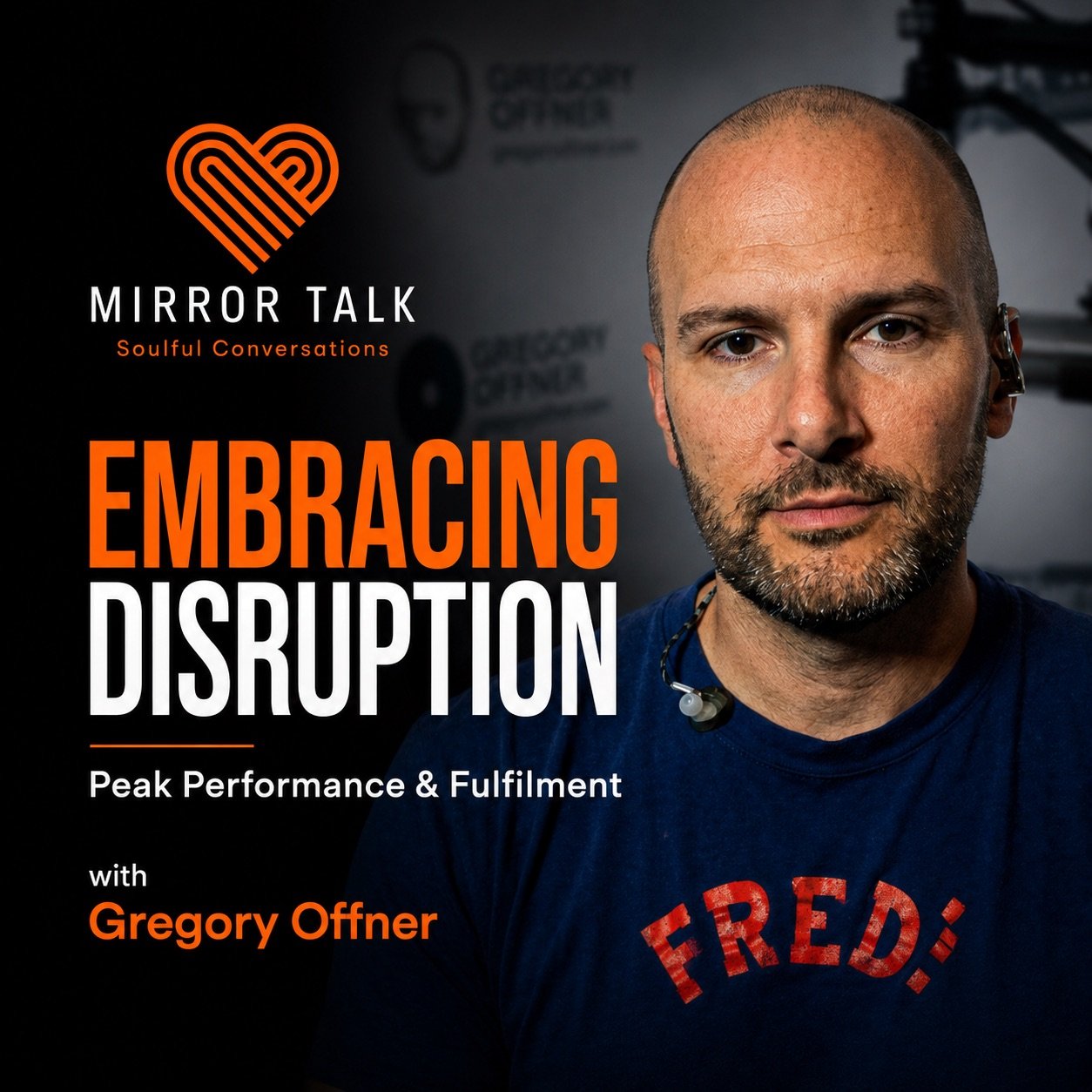
Disruption rarely arrives at a convenient time.
It can take the form of an unexpected diagnosis, a lost job, a broken relationship, a failed business, or a sudden change in the future we believed we were building. Whatever form it takes, disruption interrupts our routines and forces us to confront questions we may have spent years avoiding.
Who are we when the familiar parts of our identity disappear?
Gregory Offner understands this question personally.
Before becoming an award-winning keynote speaker and professional performance expert, Gregory spent 15 years working in sales and marketing while also pursuing his passion as a duelling pianist. His professional life and creative identity both depended heavily on his ability to communicate and perform.
Then he lost his voice.
A serious vocal cord injury led to 15 surgical procedures and long periods of complete silence. Gregory was not only dealing with a medical challenge. He was facing the potential loss of two careers and an important part of the person he believed himself to be.
During our conversation on Mirror Talk: Soulful Conversations, Gregory explains how this period transformed his relationship with work, performance, leadership and change.
Disruption Creates an Opportunity to Reset
Change and disruption are not exactly the same.
Change may simply alter our circumstances. Disruption challenges an established pattern so deeply that returning to the previous standard may no longer be possible.
This can initially feel frightening. We naturally want to restore the life we had before the disruption occurred. But sometimes our old standard is no longer the standard we should be trying to recover.
A disruption can invite us to pause, examine what was not working and consciously establish something new.
That does not mean pretending adversity is pleasant or automatically beneficial. Some experiences are genuinely painful. The opportunity comes from deciding what we will build from the experience rather than allowing the experience to make every future decision for us.
Your Inputs Influence Your Outcomes
One of the most practical lessons from Gregory’s work is the importance of examining our inputs.
Our lives produce outputs: decisions, habits, emotions, relationships, performance and results. Those outputs are shaped by the information, beliefs, conversations and environments we repeatedly consume.
When we feel stuck, we often try harder while continuing to rely on exactly the same inputs.
We read the same information, speak with the same people, repeat the same routines and reinforce the same assumptions. We then become frustrated when our results remain unchanged.
Improving an output may require changing what feeds it.
That could mean seeking a different perspective, developing a new skill, changing an unhelpful routine, finding a mentor or questioning a belief we have treated as fact.
Small changes in input can gradually create significant changes in direction.
Technical Ability Is Not Enough
Professional development is often dominated by technical skills: qualifications, software, processes, certifications and specialised knowledge.
These abilities matter, but they are not the entire foundation of performance.
Gregory distinguishes technical skills from tactical human skills such as communication, listening, collaboration, emotional awareness, adaptability and the ability to build trust.
A person can be technically brilliant and still struggle to lead a team, communicate an idea or respond constructively to pressure.
As technology and artificial intelligence continue to change how work is performed, these deeply human capabilities may become even more important. Knowledge can help us complete a task. Human skills determine how effectively we work with people while completing it.
Ask a human question. Receive insight grounded in real conversations.
Why Companies Should Develop Their People
Some organisations fear that investing in employees will make them more attractive to other employers.
But refusing to develop people carries a greater risk: creating a workforce that is disengaged, underprepared and unable to meet changing demands.
People generally want to know that their effort matters. They want opportunities to grow, contribute and feel connected to something meaningful.
This does not mean every day at work must feel inspirational. It means organisations should create environments where people experience reasonable levels of meaning, belonging, safety and progress.
Employee development should not be treated as a reward reserved for a small group of future executives. It should be part of creating a healthy and adaptable organisation.
What to Do When Work Sucks
Leaving an unfulfilling job is not always immediately possible.
People have financial responsibilities, families, immigration concerns, health needs and other realities that make simplistic advice such as “just quit” irresponsible.
However, staying temporarily does not mean surrendering completely.
You can begin by identifying the specific part of the experience that feels unbearable. Is it the work itself, the manager, the environment, the schedule, the lack of meaning or the absence of progress?
A clear diagnosis creates more options than a general feeling of helplessness.
You can then begin changing the inputs available to you: learning something new, expanding your network, requesting different responsibilities, establishing better boundaries or developing a realistic transition plan.
The goal is not to make a reckless escape. It is to recover a sense of agency.
High-Performing Leadership Begins Within
Leadership is frequently associated with authority, seniority or position. Gregory offers a more foundational perspective: meaningful leadership begins with self-leadership.
Before we can lead others consistently, we need to understand our own standards, habits, reactions and values.
Can we regulate ourselves during disruption?
Can we take responsibility without collapsing into shame?
Can we listen when another person’s perspective challenges our own?
Can we act according to our values when doing so is uncomfortable?
Titles may give us authority, but self-leadership determines how responsibly we use it.
Gregory’s journey reminds us that disruption can silence one version of our lives while revealing another. The interruption may not have been chosen, but our response can still become intentional.
The question is not only, “How do I return to the person I was?”
A more powerful question may be:
“What new standard am I being invited to create?”
In This Episode, You Will Learn
- How Gregory rebuilt his life after undergoing 15 vocal cord surgeries
- Why disruption can create an opportunity to establish a new standard
- How to change the way you think about unexpected change
- Why organisations should invest in the growth of their people
- The difference between technical skills and tactical human skills
- How changing your inputs can transform your outcomes
- What to do when your work feels unfulfilling or unbearable
- Practical ways to improve your performance immediately
- Why meaning, belonging and safety influence employee engagement
- How assuming positive intent can improve relationships
- Why self-leadership is the foundation of effective leadership
- How to transform adversity into greater impact and purpose
Memorable Ideas
Disruption does not automatically improve us. Its value depends on how consciously we respond to it.
The information, people, beliefs and habits we repeatedly allow into our lives become the inputs that shape our results.
Professional development should not focus exclusively on technical knowledge. Communication, self-awareness, listening, collaboration and adaptability are equally important.
Leadership begins with personal responsibility. We cannot consistently elevate other people without first learning to lead ourselves.
Watch on YouTube: https://youtu.be/O5sJwHd-h78
Try Aletheia today: https://aletheia.mirrortalkpodcast.com
Ask what is on your heart. Mirror Talk will reflect back what may help you see more clearly. Try it here: https://mirrortalkpodcast.com/ask-mirror-talk/
Thank you for joining me on this MIRROR TALK podcast journey. Please subscribe to any platform and remember to leave a review and rating.
Stay connected: https://lnkfi.re/mirrortalk
More inspiring episodes and show notes are here: https://mirrortalkpodcast.com/podcast-episodes/
Your opinions, thoughts, suggestions, and comments are important to us. Please share them here: https://mirrortalkpodcast.com/your-opinion-matters/
Could you support us by becoming a Patreon? Please consider subscribing to one or more of our offerings at http://patreon.com/MirrorTalk
All proceeds will help enhance the quality of our work and outreach, enabling us to serve you better.
We use and trust these podcasting tools, software, and gear. We’ve partnered with amazing platforms to give our Mirror Talk community exclusive deals and discounts: https://mirrortalkpodcast.com/best-podcasting-tools/
Spiritual Awakening, Surrender & Ego Management (with Cristine Hull) – Mirror Talk: Soulful Conversations
- Spiritual Awakening, Surrender & Ego Management (with Cristine Hull)
- Your Daily Dose Of Positivity: Start Here (with Rhonda Britten)
- Are You Ready for What's Next? (with Natalie Bouchard)
- From Pain to Purpose: Red Light Therapy, Resilience & Recovery (John Graham Harper)
- Feeling disconnected? Navigating your Dark Night of the Soul (with Rhonda Britten)