
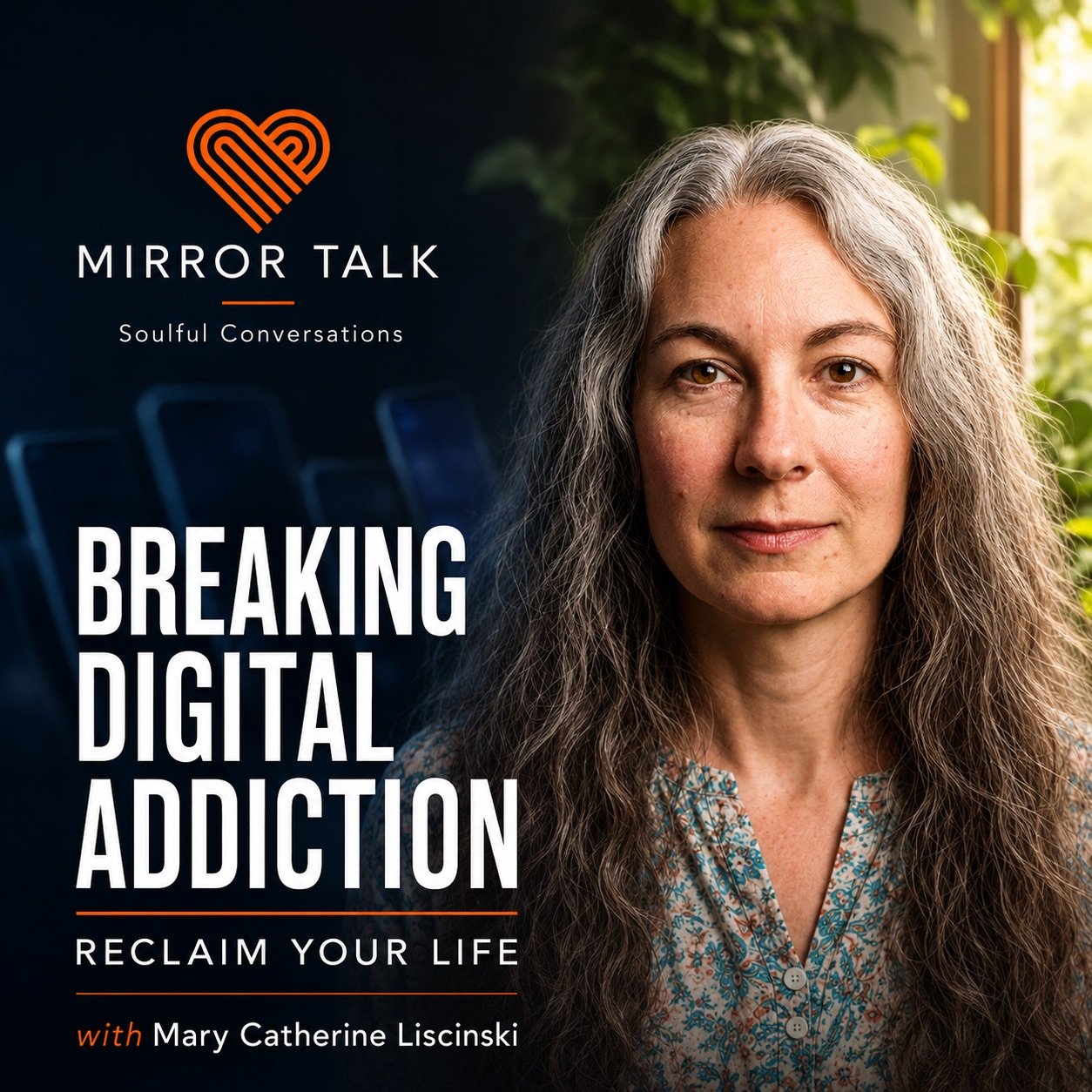
Learn how digital addiction and excessive screen time affect our minds, relationships and families.
How often do you reach for your phone without consciously deciding to?
Maybe it happens first thing in the morning. Perhaps you open one notification and suddenly realize that twenty minutes have disappeared. Or maybe you have sat in a room with people you love while everyone quietly looked down at separate screens.
Technology has given us extraordinary possibilities. But somewhere between convenience, entertainment, connection, and endless access, many of us have begun to wonder whether our screens are taking more from us than we realize.
In this episode of Mirror Talk: Soulful Conversations, Tobi sits down with Mary Catherine Liscinski, a Licensed Professional Counselor, Certified Life Coach, and specialist certified to treat Digital Addiction involving smartphones, social media, and video games.
With more than 13 years of counselling experience, Mary works with teens, adults, and families who want healthier relationships with technology—and with one another.
Our conversation explores what excessive screen time can do to our mental well-being, relationships, communication, attention, and ability to simply be present.
But this is not a conversation about blaming technology.
It is about learning how to use it without allowing it to quietly take over our lives.
When Does Screen Time Become a Problem?
Most of us use screens every day.
We work on them. We communicate through them. We learn, relax, watch, listen, shop, create, and connect through them.
So the goal is not necessarily to eliminate technology.
The deeper question is:
Are we still choosing when and how we use our devices—or have our habits begun choosing for us?
Mary explains that problematic digital habits can begin showing up in subtle ways.
Someone may become less interested in face-to-face interaction. Communication skills may suffer. Family members may spend increasing amounts of time physically together while emotionally disconnected.
For teenagers, excessive screen use can affect school, relationships, social development, and emotional well-being.
Adults are not immune.
Scrolling can become an automatic response to boredom, discomfort, loneliness, stress, or even a few seconds of silence.
And because many digital platforms are intentionally designed to hold our attention, simply telling ourselves to “use the phone less” is not always enough.
Why Are Screens So Difficult to Put Down?
Ask a human question. Receive insight grounded in real conversations.
One of the most important parts of our conversation with Mary is understanding that digital addiction is not simply about having weak discipline.
Many apps, social networks, games, and online experiences are built around systems that encourage repeated engagement.
There is always another notification.
Another video.
Another post.
Another level.
Another message.
Another reason to keep looking.
The result can be a pattern in which our attention becomes fragmented and our minds become accustomed to constant stimulation.
And when stimulation becomes normal, stillness can begin to feel uncomfortable.
That matters because some of the most meaningful parts of life require the very things constant digital stimulation can make harder: patience, presence, listening, reflection, conversation, creativity, and genuine human connection.
What Are We Losing When We Are Always Connected?
One of the most powerful themes in this episode is the difference between being digitally connected and being genuinely connected.
Understanding the conversation
A person can have hundreds of online interactions in a day and still feel lonely.
A family can sit together in one room without really being together.
A conversation can be interrupted repeatedly by notifications.
A quiet walk can become another opportunity to consume content.
None of these moments seems catastrophic on its own.
But our lives are made of moments.
Mary encourages us to pay attention to what excessive screen use may be replacing.
Time outside.
Conversation.
Sleep.
Reading.
Movement.
Reflection.
Relationships.
Boredom.
Even boredom has value. It creates space for imagination, creativity, and thought.
When every empty moment is immediately filled by a screen, we may unknowingly remove some of the space in which we actually encounter ourselves.
Can We Reverse the Effects of Excessive Screen Time?
The encouraging answer is yes.
Mary emphasizes practical ways to begin rebuilding a healthier relationship with technology.
Simple boundaries can make a meaningful difference.
Using timers.
Creating screen-free periods.
Spending more time outdoors.
Choosing face-to-face conversations.
Being intentional about when devices are present during meals or family time.
Practicing mindfulness.
And perhaps most importantly, noticing our habits without immediately condemning ourselves for having them.
Change begins with awareness.
You cannot consciously change a pattern you have never stopped to notice.
For families, Mary also encourages parents to think beyond punishment and restriction.
Healthy technology boundaries work best when the entire family understands what they are trying to protect.
The goal is not simply fewer hours on a device.
The goal is more of something else:
More conversation.
More presence.
More connection.
More sleep.
More creativity.
More movement.
More real life.
Faith, Presence and Living Intentionally
Mary’s Christian faith also plays an important role in how she thinks about well-being, relationships, and intentional living.
During our conversation, we explore how faith can provide grounding in a culture constantly competing for our attention.
Her perspective also connects beautifully with something she learned from her grandmother: slow down and make life about people, not things.
Relationships in practice
That wisdom feels increasingly relevant today.
Our devices constantly invite us somewhere else.
Someone else’s life.
Someone else’s opinion.
Someone else’s photograph.
Someone else’s achievement.
Someone else’s emergency.
But life is still happening here.
In the room we are sitting in.
With the people beside us.
Inside the conversation we are having.
During the walk we almost did not take.
In the silence we usually rush to fill.
Reclaiming Your Attention Is Reclaiming Part of Your Life
This episode is ultimately not about becoming anti-technology.
Technology can enrich our lives enormously.
The challenge is remembering its proper place.
It should be a tool within our lives—not the place where most of our lives disappear.
If you have been feeling distracted, overwhelmed by social media, concerned about your children’s screen habits, or simply aware that you are spending more time online than you would like, this conversation offers something more useful than guilt.
It offers perspective.
Practical steps.
And hope.
Mary’s message is simple and important:
Don’t give up on yourself.
Habits can change.
Families can reconnect.
Attention can be rebuilt.
And it is possible to develop a healthier relationship with technology without abandoning the digital world altogether.
Perhaps the first step is simply asking:
What would I have more room for in my life if I spent a little less time looking at a screen?
Listen to the full conversation with Mary Catherine Liscinski on Mirror Talk: Soulful Conversations.
Connect with Mary Catherine Liscinski
Learn more about Mary’s work and her upcoming book on Digital Addiction: https://lifewalkcoaching.com/screen-addiction-book/
Watch on YouTube: https://youtu.be/IPz5gpQTsdk
In This Episode, We Explore
Digital addiction and excessive screen time; smartphone, social media, and video game addiction; the psychological pull of digital platforms; screen time and mental health; technology’s impact on families and relationships; healthier screen boundaries for parents and teenagers; digital detox strategies; mindfulness and presence; spending more time in nature; rebuilding face-to-face connection; faith and digital wellness; and how to reclaim your attention in an increasingly screen-dominated world.
Continue Your Journey
Read CONFESSIONS: A personal invitation to reflection, healing and honest self-discovery: https://mirrortalkpodcast.com/confessions-book/
Try Aletheia: Receive calm, personalised biblical wisdom for the questions and decisions shaping your life: https://aletheia.mirrortalkpodcast.com
Ask Mirror Talk: Share what is on your heart and receive a thoughtful reflection that may help you see your situation more clearly: https://mirrortalkpodcast.com/ask-mirror-talk/
Support Mirror Talk
Thank you for being part of the Mirror Talk: Soulful Conversations community.
Follow or subscribe on Spotify, Apple Podcasts or your preferred podcast platform so you do not miss future conversations about personal growth, spirituality, healing, purpose, relationships, leadership and intentional living.
Your rating, review and shared recommendation help more people discover the podcast.
You can also support our work and outreach by becoming a Mirror Talk Patreon member: http://patreon.com/MirrorTalk