
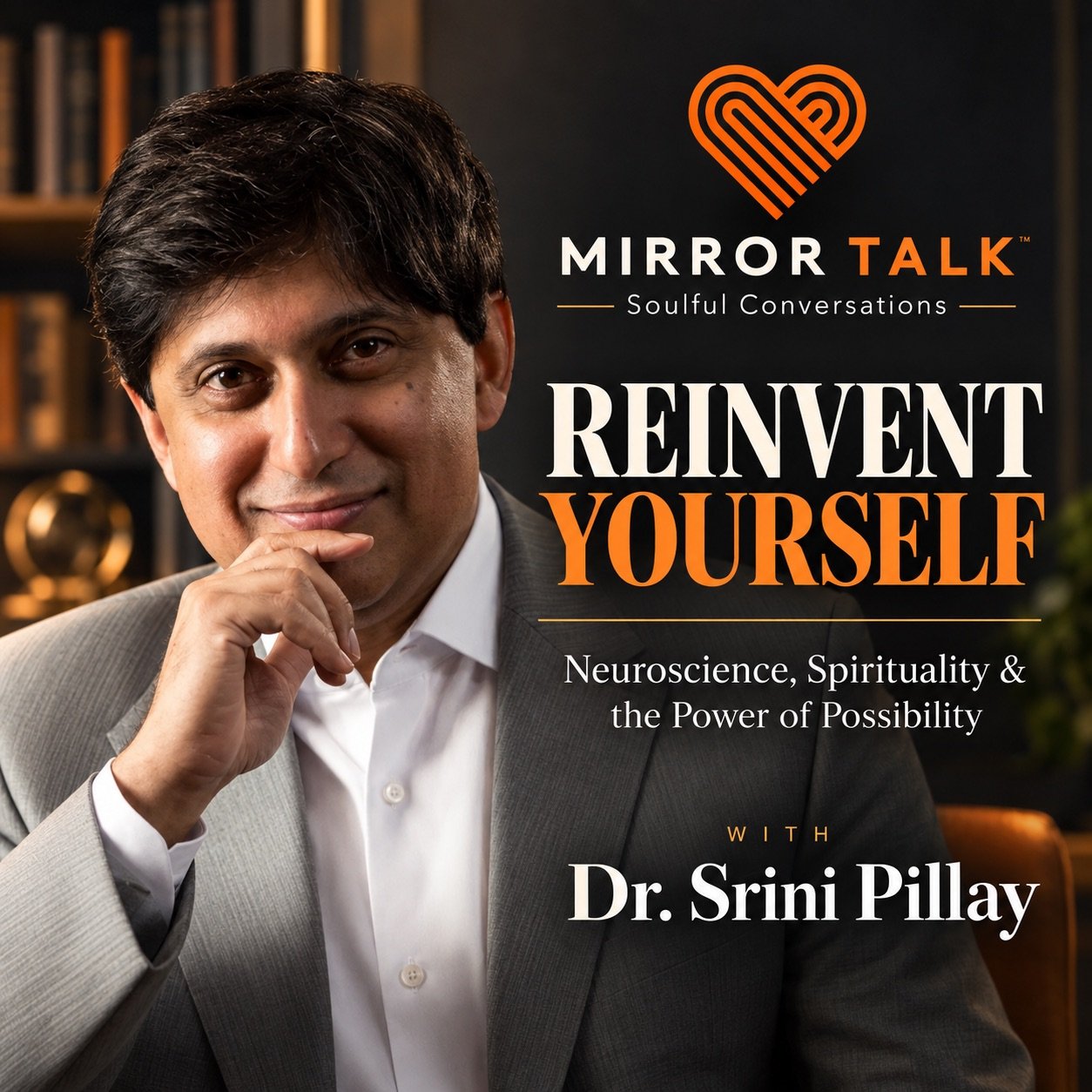
Harvard-trained psychiatrist Dr. Srini Pillay explores neuroscience, spirituality, focus and unfocus, AI, longevity and how to reinvent yourself without losing who you are.
What happens when the life, identity, or future you imagined no longer fits?
Our instinct is often to work harder, focus more intensely, and try to force our way forward.
But what if genuine reinvention requires something different?
In this episode of Mirror Talk: Soulful Conversations, we explore that question with Dr. Srini Pillay, a Harvard-trained psychiatrist, brain-imaging researcher, author, entrepreneur, and thinker whose work brings together neuroscience, leadership, creativity, spirituality, technology, and human possibility.
At the heart of our conversation is a question almost everyone eventually faces:
How do we become who we need to become without losing who we are?
Ask a human question. Receive insight grounded in real conversations.
Reinvention Is More Than Changing What You Do
We often think of reinvention as changing careers, moving somewhere new, beginning another relationship, starting a company, or adopting different habits.
But the deeper work happens at the level of identity.
Who are you when the old definition of yourself no longer works?
Dr. Pillay’s own journey has crossed remarkably different worlds—from growing up in South Africa to medicine, psychiatry, brain research, Harvard, leadership development, entrepreneurship, creativity, spirituality, and emerging technology.
That breadth leads us into an important idea throughout the conversation: the human being cannot always be understood by separating life into neat categories.
Our biology, beliefs, relationships, imagination, spirituality, fears, ambitions, and sense of meaning continually interact.
Reinvention therefore isn’t simply about doing something different.
It can require seeing yourself differently.
Watch on YouTube: https://youtu.be/-UDr1MgOJXU
Your Brain Needs More Than Focus
Modern culture has built an enormous industry around attention.
Focus.
Concentrate.
Eliminate distraction.
Be productive.
But the brain wasn’t designed to remain intensely focused every waking moment.
One of Dr. Pillay’s most fascinating areas of work concerns the value of unfocus—giving the mind room to wander, imagine, connect seemingly unrelated ideas, play, and explore.
That does not mean abandoning discipline.
It means recognizing that focus and unfocus perform different functions.
Some problems need concentration.
Others need space.
That distinction matters enormously for creators, entrepreneurs, leaders, and anyone attempting to find a way forward when the obvious answers no longer work.
Sometimes another hour of forcing the problem isn’t what your mind needs.
Sometimes it needs permission to wander.
When Survival Mode Becomes a Way of Life
We also explore what happens when pressure stops being temporary.
Many people are functioning under persistent anxiety, uncertainty, responsibility, comparison, and performance demands. The body may be sitting at a desk or lying in bed, while the brain continues behaving as though something dangerous is about to happen.
And when survival becomes our default state, possibility can become harder to see.
Fear narrows the horizon.
This makes the conversation about belief particularly important.
Our beliefs don’t merely exist as abstract ideas. They influence what we pay attention to, what possibilities we notice, which risks we tolerate, and what actions we consider available to us.
That doesn’t mean pretending reality is always positive.
It means understanding that our interpretation of reality helps determine how we respond to it.
Spirituality, Health and the Inner Life
One of the most compelling parts of this conversation moves beyond performance into a much bigger question:
What relationship might our inner life have with the health of our outer life?
Dr. Pillay explores the developing field around mindset, spirituality, meaning, well-being, healthspan, and longevity.
It is an important counterweight to the idea that human health can be understood through numbers alone.
Sleep matters.
Movement matters.
Nutrition matters.
Medicine matters.
But so do meaning, belonging, connection, curiosity, purpose, hope, and how we experience being alive.
We are beginning to ask not simply how to live longer, but how to remain more fully alive while we are here.
Remaining Human in the Age of AI
The conversation naturally leads us to artificial intelligence.
Technology will continue becoming more capable.
The deeper question is whether human beings will become more human alongside it.
Dr. Pillay’s work explores how neuroscience, AI and immersive technologies may be used to support well-being and human development. But the conversation also points toward something technology cannot answer for us:
What kind of person do I want to become?
AI can give us information.
It can generate possibilities.
It can accelerate work.
But meaning, wisdom, connection, love, curiosity and responsibility remain deeply human questions.
Perhaps the challenge ahead is not to compete with machines at being machines.
Perhaps it is to become better at being human.
When an Ending Might Actually Be Transformation
Toward the end of our conversation, we return to an image associated with transformation:
What appears to the caterpillar as an ending becomes the beginning of the butterfly.
There are seasons when that idea can sound almost impossible to believe.
A career ends.
A relationship changes.
A dream fails.
An identity stops fitting.
The future becomes unclear.
But uncertainty is not always evidence that something has gone wrong.
Sometimes it is what transformation feels like before we understand what is happening.
And perhaps reinvention begins when we become curious enough to ask:
What if this isn’t only the end of something? What if something else is trying to emerge?
Listen to the full conversation with Dr. Srini Pillay on Mirror Talk: Soulful Conversations.
Connect with Dr. Srini Pillay
Website: https://drsrinipillay.com/
LinkedIn: https://www.linkedin.com/in/srinipillay/
X/Twitter: https://twitter.com/DrSriniPillay
Continue Your Journey
Read CONFESSIONS: A personal invitation to reflection, healing and honest self-discovery: https://mirrortalkpodcast.com/confessions-book/
Try Aletheia: Receive calm, personalised biblical wisdom for the questions and decisions shaping your life: https://aletheia.mirrortalkpodcast.com
Ask Mirror Talk: Share what is on your heart and receive a thoughtful reflection that may help you see your situation more clearly: https://mirrortalkpodcast.com/ask-mirror-talk/
Support Mirror Talk
Thank you for being part of the Mirror Talk: Soulful Conversations community.
Follow or subscribe on Spotify, Apple Podcasts or your preferred podcast platform so you do not miss future conversations about personal growth, spirituality, healing, purpose, relationships, leadership and intentional living.
Your rating, review and shared recommendation help more people discover the podcast.
You can also support our work and outreach by becoming a Mirror Talk Patreon member: http://patreon.com/MirrorTalk

Someone Told Me To Stop Doing This (And They Were Right) – Mirror Talk: Soulful Conversations
- Someone Told Me To Stop Doing This (And They Were Right)
- Why Manifestation Isn’t Working: Resistance, Self-Love & Divine Timing (Kelsey Aida)
- Why You Need A 'Champion Mindset' To Win In Life
- Spiritual Awakening, Surrender & Ego Management (with Cristine Hull)
- Your Daily Dose Of Positivity: Start Here (with Rhonda Britten)