

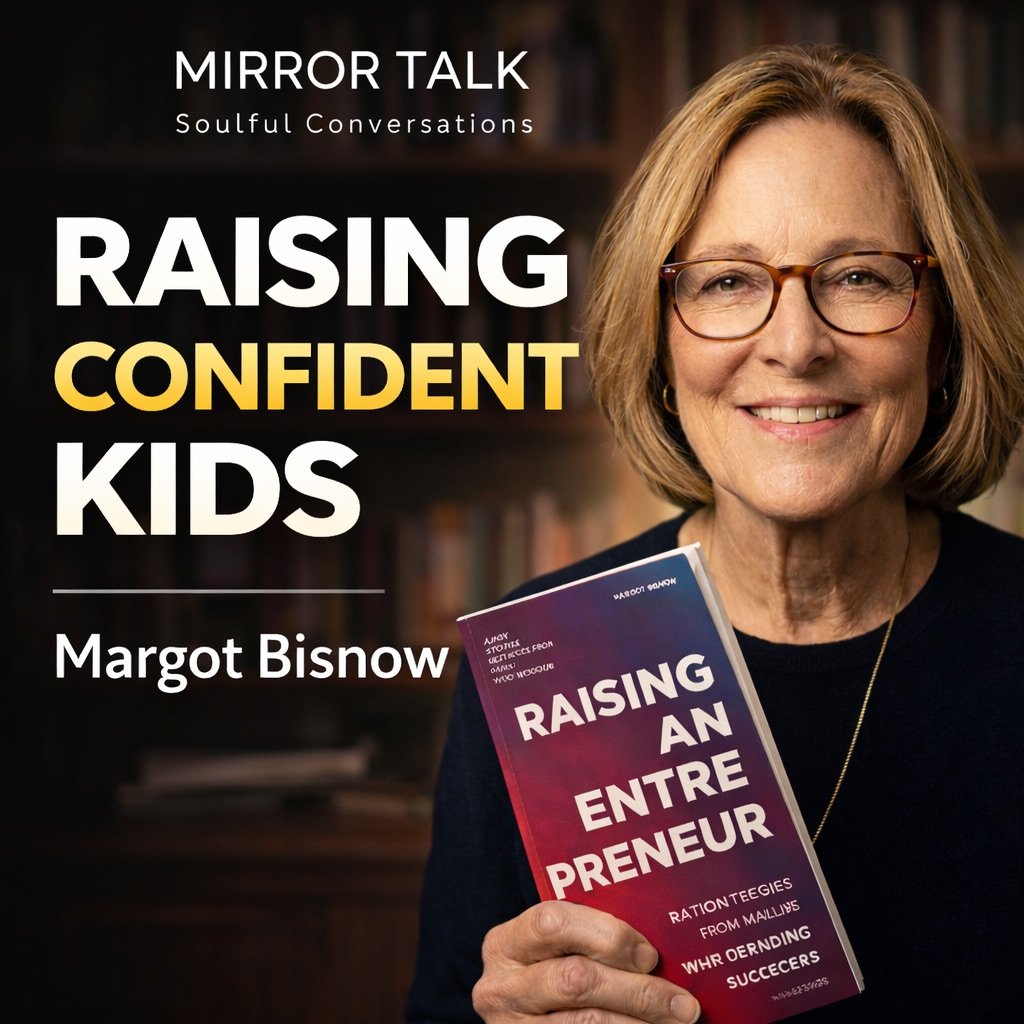
In a world obsessed with achievement, performance, and security, many children are growing up with full schedules but little space to discover who they really are.
That is one of the most powerful themes in this conversation with Margot Machol Bisnow, former FTC Commissioner and author of Raising an Entrepreneur. While her book explores the stories of families who raised entrepreneurial children, the deeper message reaches far beyond business or career success. At its heart, this is a conversation about how to raise confident, purpose-driven children who are emotionally healthy, resilient, and free enough to follow what brings them alive.
For parents, mentors, and anyone invested in the next generation, this discussion offers both wisdom and relief. Because raising a child with ambition and soul is not about controlling their future. It is about creating the kind of environment where courage, joy, and self-belief can grow.
What Margot Machol Bisnow Learned from 99 Families
Margot interviewed 99 families whose children grew into innovators, creators, and entrepreneurs. The families came from different cultures, economic backgrounds, and life experiences. Yet again and again, certain patterns emerged.
The most striking insight was not that these children were pushed harder, managed more tightly, or forced into excellence. It was that many of them had parents who truly saw them. Parents noticed what sparked their curiosity. They paid attention to what gave them joy. And instead of dismissing those passions as unrealistic, distracting, or impractical, they supported them.
That support became a foundation for courage later in life.
Children who grow up feeling believed in often carry that belief into adulthood. It becomes the quiet inner strength that helps them take risks, recover from setbacks, and trust their own voice.
Why So Many Children Feel Lost
One of the strongest ideas in this episode is that many children are unhappy not because they lack opportunity, but because they lack space.
They are told what success should look like. They are moved from task to task, expectation to expectation, often with very little room to listen inwardly. When every hour is filled and every decision is shaped by pressure, children can lose touch with what they actually love.
Creating space does not mean abandoning structure or responsibility. It means leaving room for exploration. It means noticing when a child lights up. It means allowing interests to develop even when they do not immediately fit the standard script of academic achievement or prestige.
A child who is given room to explore their own interests may not always follow the most conventional path. But they are far more likely to develop ownership, purpose, and confidence.
Ask a human question. Receive insight grounded in real conversations.
The Difference Between Protection and Preparation
Many parents want to protect their children from disappointment. That instinct comes from love. But overprotection can sometimes weaken the very qualities children need most.
Margot speaks to the importance of resilience, and this is one of the most timely lessons in the entire conversation. Children do not become strong because life is made easy for them. They become strong because they are allowed to try, fail, adapt, and try again with support.
This is where many families struggle. Failure is often treated as something shameful, something to avoid at all costs. But in the families Margot studied, failure was frequently reframed as part of growth.
That shift matters.
When children are taught that failure is not the end of their worth, they become more willing to experiment, create, lead, and persist. They stop seeing setbacks as proof that they are not enough. Instead, they begin to see them as part of becoming.
Parenting Through Fear of Nontraditional Paths
For many parents, especially those who have had to fight for stability, supporting an unconventional path can feel deeply risky.
This part of the conversation is especially meaningful. Margot acknowledges the real fear parents may feel when a child expresses interest in a path that does not seem secure, respectable, or traditional. That fear is understandable. But fear can also lead parents to shut down the very gifts their children were born to develop.
Supporting a child’s joy is not the same as neglecting wisdom. It means staying curious long enough to understand what is really there. It means asking better questions. It means resisting the urge to dismiss a dream simply because it looks unfamiliar.
Children do not always need parents who have all the answers. They need parents who are willing to see them clearly.
Raising Children with Ambition and Soul
One of the most beautiful ideas in this episode is that this is not merely a conversation about entrepreneurship. It is about wholeness.
To raise a child with ambition and soul means nurturing both drive and depth. It means helping them grow in confidence without losing compassion. It means encouraging excellence without making achievement their identity. It means teaching them to pursue meaningful work while staying rooted in kindness, gratitude, creativity, and love.
These values shaped Margot’s own approach to parenting, and they offer a grounded framework for families who want to raise children that are not just impressive on paper, but healthy from within.
Because the ultimate goal is not to produce a child who performs well under pressure. It is to raise a human being who knows who they are.
What This Means for Parents Today
This episode offers a needed reminder for modern families.
Your child does not need a life that looks perfect from the outside. They need to feel seen, supported, and safe enough to become themselves. They need opportunities to discover joy. They need permission to fail without shame. And they need adults who understand that success is not only about achievement, but about alignment.
If you want to raise confident, purpose-driven children, start by paying attention. Notice what energizes them. Notice where they come alive. Notice what they return to naturally. Then support that with wisdom, patience, and love.
That is where courage begins.
Listen to the Full Episode
In this episode of Mirror Talk: Soulful Conversations, Margot Machol Bisnow shares practical and deeply human insights on parenting, passion, resilience, and the inner foundations of success.
If this conversation resonates with you, share it with a parent, educator, mentor, or anyone helping shape the next generation.
Watch on YouTube: https://youtu.be/E-deTtrZGtI
Ask what is on your heart. Mirror Talk will reflect back what may help you see more clearly. Try it here: https://mirrortalkpodcast.com/ask-mirror-talk/
Thank you for joining me on this MIRROR TALK podcast journey. Please subscribe to any platform and remember to leave a review and rating.
Stay connected: https://linktr.ee/mirrortalkpodcast
More inspiring episodes and show notes are here: https://mirrortalkpodcast.com/podcast-episodes/
Your opinions, thoughts, suggestions, and comments are important to us. Please share them here: https://mirrortalkpodcast.com/your-opinion-matters/
Could you support us by becoming a Patreon? Please consider subscribing to one or more of our offerings at http://patreon.com/MirrorTalk
All proceeds will help enhance the quality of our work and outreach, enabling us to serve you better.
We use and trust these podcasting tools, software, and gear. We’ve partnered with amazing platforms to give our Mirror Talk community exclusive deals and discounts: https://mirrortalkpodcast.com/best-podcasting-tools/

Spiritual Awakening, Surrender & Ego Management (with Cristine Hull) – Mirror Talk: Soulful Conversations
- Spiritual Awakening, Surrender & Ego Management (with Cristine Hull)
- Your Daily Dose Of Positivity: Start Here (with Rhonda Britten)
- Are You Ready for What's Next? (with Natalie Bouchard)
- From Pain to Purpose: Red Light Therapy, Resilience & Recovery (John Graham Harper)
- Feeling disconnected? Navigating your Dark Night of the Soul (with Rhonda Britten)